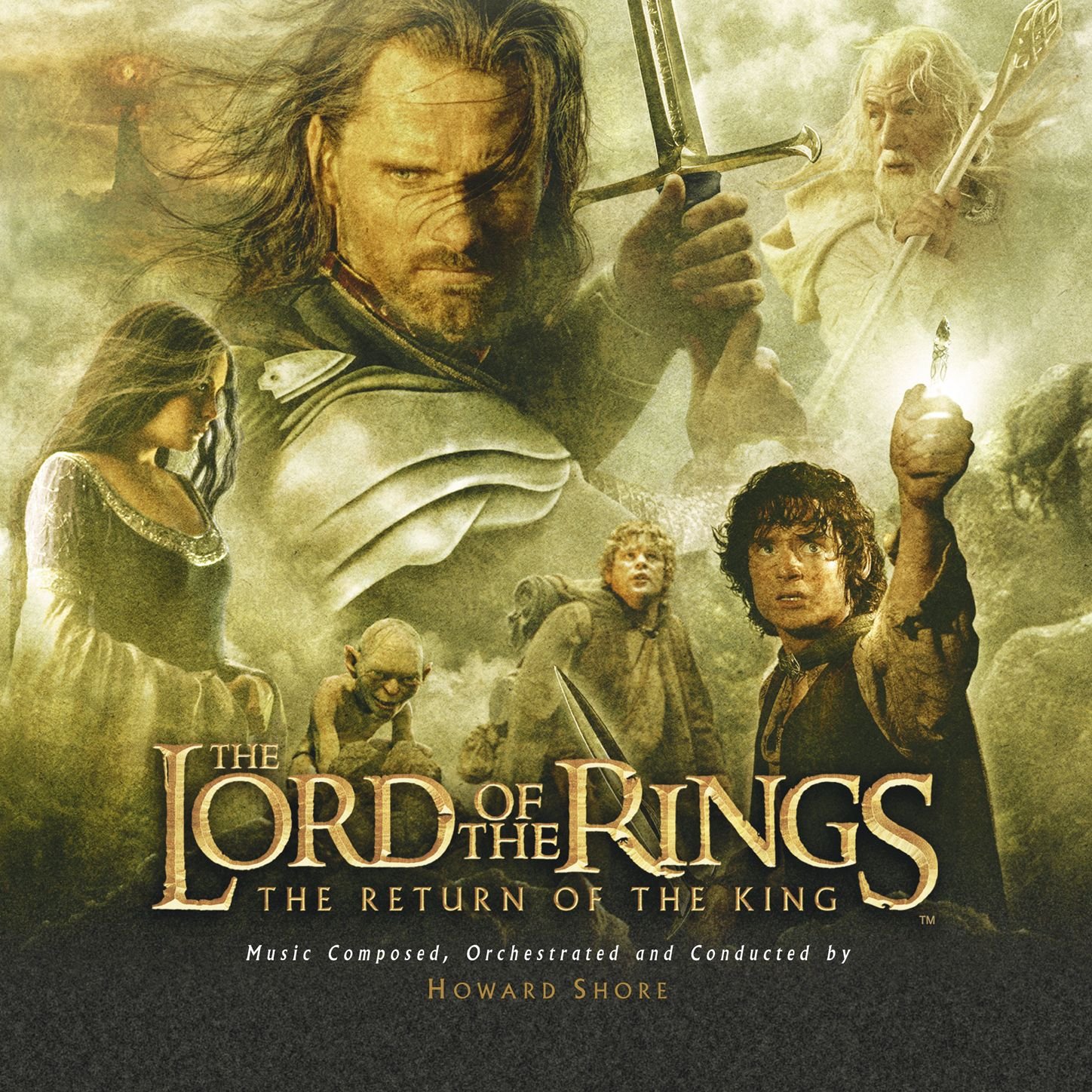
The Lord of the Rings: The Return of the King
“Howard Shore outdoes himself with the strongest score in his arsenal.”
Gandalf and Aragorn lead the World of Men against Sauron’s army to draw his gaze from Frodo and Sam as they approach Mount Doom with the One Ring.
Shore’s sendoff to the original trilogy is among the best ever written.
The final film in Peter Jackson’s epic trilogy was a force to be reckoned with. The sheer immensity of its achievements cannot be understated. Howard Shore’s score to the finale is a fitting finale in itself.
What Shore does so well is the art of the battle track. The film is ultimately one large battle for control of Middle Earth. A good battle track should be vibrant, heavy on the drums and on the brass. But it’s so easy to get tiring battle pieces when the tracks get repetitive and have no payoff on the buildup. Howard Shore is excellent at providing that payoff.
The Highlights
An uplifting orchestra medley quickly gives way to the rousing theme that underpins the trilogy. I can’t tell if it’s the theme to the King of Gondor or just the general LOTR. Despite its short length, it’s an excellent track.
It starts with a slow string opening. Howard Shore plans to remind the viewer of the weight of the threat surrounding Minas Tirith. Moody brass accents underpin the heat of the situation before the strings return about a minute in. It then descends into a full flurry of orchestration that is a clear battle track. As the battle rages, the choir inserts itself into the fray before the brass section clears it away. Silence follows immediately when Ben Del Maestro inserts his voice. He was a young singer at the time. After that point, the song ends in a rousing victory theme.
This track begins quietly enough and is unremarkable until about halfway through. But, right around a minute and 40 seconds in comes the theme when the men of Middle Earth light their beacons, calling aid for Gondor. The strings are rapid firing and changing their pitch non-stop. The brass then inserts itself into an escalating show of force. The piece builds in volume and luminosity until its final minute, when it just unleashes itself in an absolutely brilliant finish. It’s incredibly wonderful to listen to and a track that you want to hear on repeat.
This song IS the lighting of the beacons. It’s everything that the scene needed.
Opening with a more muted rendition of the main theme and later accented by a flute, “The Steward of Gondor” isn’t one of the most exciting tracks on the album. But it does demonstrate remarkable depth. It goes from accent piece to theme piece to battle track and finally into a memorial piece. Billy Boyd sings the finale to almost pure silence, and his voice is neither excellent nor deep, but it works perfectly with a shrill strings backing and then a fitting outro.
This is the track that played when the horses rode into battle. It starts with a brass section that’s heavy on accents and then quiets down for about a minute before it launches into an epic finale. The middle component, soloed by a flute or some other woodwind, provides some brief levity before it immediately amps up.
If you had to imagine a dream state, “Twilight and Shadow” would sound like it. At least for the beginning. A single solo voice sings a tune with no words, but I think there is a chorus providing backing choral sounds to the vocalist. I can’t quite tell. A harp plays in the background. 90 seconds in, the intensity changes but not the tune. The orchestra has now joined in force, just missing the heavier-hitting drums and potentially brass bits. As the song fades, we get to experience the vocalist again, sending us back into that dream state.
Another pure dream-state track. A choir starts this one with a dream-like hum, and it continues with various interjections by the broader orchestra.
The Fields of the Pelennor—6/5
The “Fields of the Pelennor” is a sweeping, intense orchestral piece that captures the chaos, heroism, and brutality of the Battle of Pelennor Fields. It opens with ominous low strings and brass, building tension before erupting into a frenzied clash of rapid string runs, bold brass fanfares, and pounding percussion, mirroring the violence of war. As Rohan charges, the triumphant Rohan theme surges forward, led by soaring horns and sweeping strings, injecting hope into the battle’s desperation. Darker, ominous tones underscore the Witch-king’s menace, with low brass and choir heightening the supernatural dread. The piece climaxes in a grand, victorious swell, with the full orchestra uniting in powerful harmonies, encapsulating the sheer scale and emotional weight of one of The Lord of the Rings’ most pivotal moments. The impact of the brass section in the final third just hit so hard that it’s a hall-of-fame track.
It opens with a resounding retelling of the heroes’ time but quickly settles into the Hobbit’s theme as they approach the end of their journey. It’s a somber, quiet reminder of the losses that everyone has faced on their path to where they are now. Hope prevails through the theme. The woodwinds dominate the artistic flow but are accented by the broader orchestra and choir. As you listen to it, it feels like a culmination of everything that made the albums before them ideal. As it fades into its closure, you get a hint of the theme of “Into the West,” just teasing you so well enough.
It jumps right into the choir. Death is pervasive in this war chant. The sense is that the final battle is upon us. 75 seconds in, the choir fades from the view, and Renee Fleming takes over with a haunting solo for the next 40 seconds before the war choir returns. The choir bumps in and out of pure energy, taking its time to build up before letting things drop again. Renee Fleming takes back over for the final minute as she solos again in a mournful tune.
As the culmination of 9 hours of movies and 3 hours and 35 minutes of music approaches its close, the longest piece in the LOTR trilogy really does justice to everything the movies have been about. It’s a resounding success. Howard Shore weaves in numerous themes. At 10 minutes long, it’s the longest track that is on the original three soundtrack releases. Viggo Mortenson himself provides a solo about 4 minutes in.
There’s so much variation in the piece that I’m having trouble really describing it. It’s a sublime work of art whose diversity is its strongest asset.
When I listen to this one, I think of softness. A soft choir halfway through. Soft strings and woodwinds are really setting the tone. The utter level of content that this piece brings is worth it.
Annie Lennox, of Eurythmics fame, provides the vocals on the final piece in the trilogy. The song is tender and reflective, with lyrics that evoke themes of longing, hope, and the idea of moving toward a peaceful and eternal rest. Annie Lennox’s ethereal voice, combined with the gentle instrumental arrangement, creates a sense of warmth and tranquility. The song carries a deeply sentimental tone, which aligns with the bittersweet conclusion of the Lord of the Rings trilogy.
Track by track
19 tracks · rated out of 5A Storm Is Coming
2:50Hope and Memory
1:45—5/5
Minas Tirith
3:37—4.5/5
The White Tree Hall of Fame
3:24—6/5
The Steward of Gondor
3:53—4/5
Minas Morgul
1:56The Ride of the Rohirrim
2:08—5/5
Twilight and Shadow
3:30—5/5
Cirith Ungol
1:43Andúril
2:35—4.5/5
Shelob's Lair
4:06Ash and Smoke
3:25The Fields of the Pelennor Hall of Fame
3:27Hope Falls
2:21The Black Gate Opens Hall of Fame
4:01—6/5
The End of All Things
5:14—4.5/5
The Return of the King Hall of Fame
10:14—6/5
The Grey Havens
5:59—4.5/5
Into the West
5:43—5/5
Time weighted averages each track’s rating by its runtime (longer tracks count more). Track weighted treats every track equally. Both are computed directly from the ratings above.